submission-requirements
4. Algorithms Used
The key algorithms in this phase are:
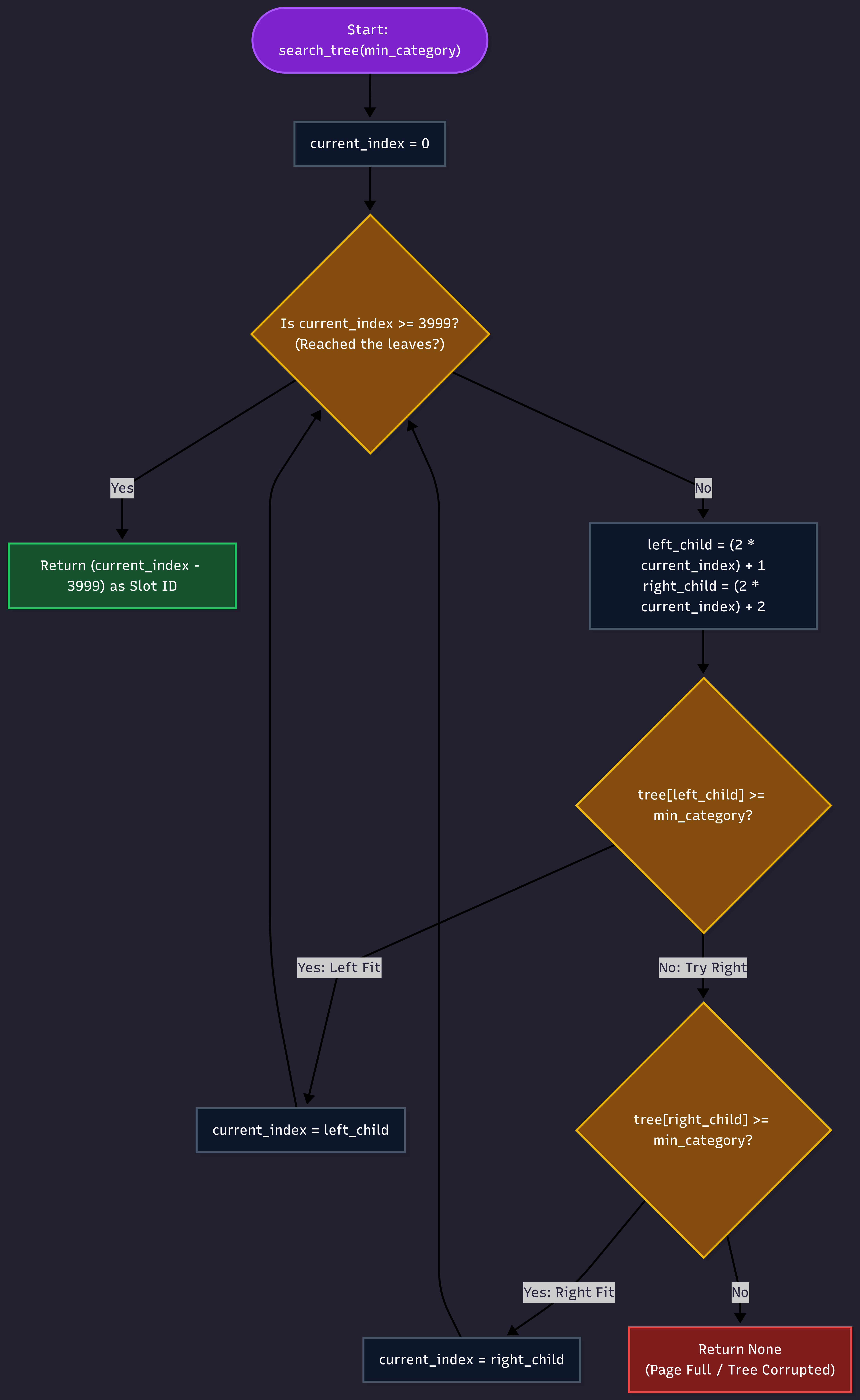
- FSM tree search for candidate page discovery using category thresholds
- FSM bubble-up updates after free-space changes
- Three-attempt insert fallback strategy for robust progress under fragmentation or stale category mismatch
- Sidecar rebuild from heap pages for recovery
FSM Search Flow Diagram
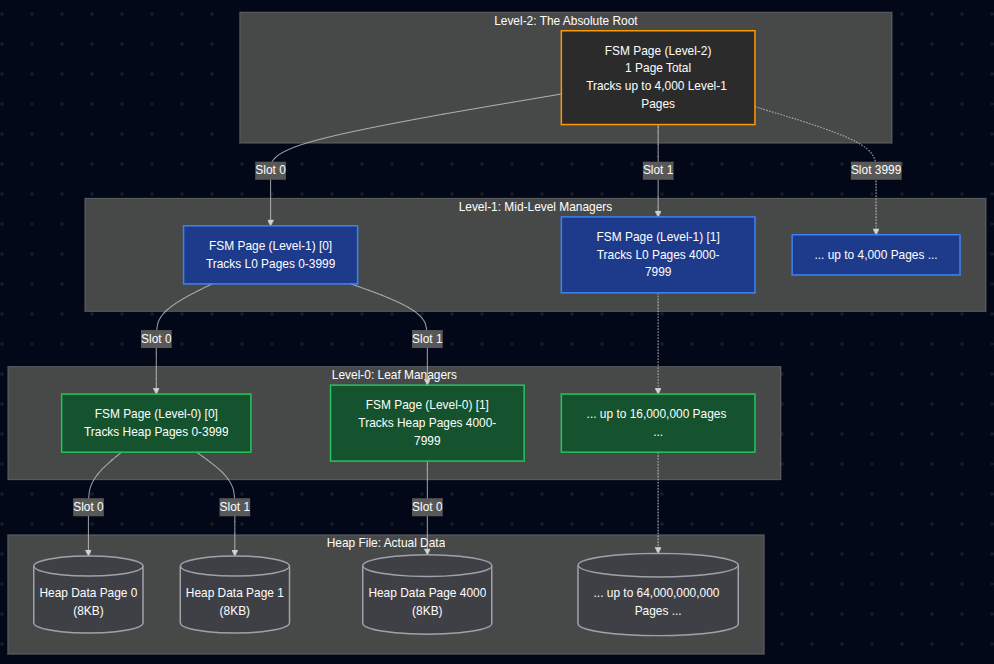
FSM Level Mapping Diagram
5. Newly Created Data Structures and Their Purpose
| Data Structure | Purpose |
|---|---|
HeaderMetadata | Persistent table-level metadata in page 0 |
FSMPage | Encodes free-space tree data inside one FSM page |
FSM | Sidecar manager for search, update, rebuild, and sync |
HeapManager | Core heap API for create/open/insert/get/delete/scan |
HeapScanIterator | Lazy iterator for page-wise sequential scans |
6. Backend Functions and Their Purpose
Heap Layer Functions
create: initialize heap and metadataopen: open heap and reconcile/rebuild FSMinsert_tuple: FSM-guided insert with fallbackget_tuple: coordinate-based lookupdelete_tuple: slot invalidation and metadata updatescan: sequential tuple iterationallocate_new_page: append and register page stateflush: sync header, heap, and FSM
FSM Layer Functions
open: open/create sidecarbuild_from_heap: reconstruct sidecar from heapfsm_search_avail: find candidate page by categoryfsm_set_avail: update category and propagate maximafsm_vacuum_update: reclaim-aware category refreshsync: persist sidecar changes
Disk and Page Functions
create_page,read_page,write_pageread_header_page,update_header_page,read_all_pagesinit_page,page_free_space,get_tuple_count,get_slot_entry
8. Benchmark Results (Available)
Representative results from the latest benchmark report include:
- strong small and large insert throughput
- high point lookup and sequential scan throughput
- low FSM rebuild latency
- correctness checks such as scan count parity and oversized tuple rejection
Canonical outputs are published under benchmark_runs/, including JSON, CSV, and comparison artifacts.
9. Potential Future Work
Planned and natural next steps include:
- full compaction-aware insert path
- richer fragmentation reclamation workflows
- expanded type support
- concurrency and contention improvements
- improved benchmark methodology with repeated runs and median/p95 reporting